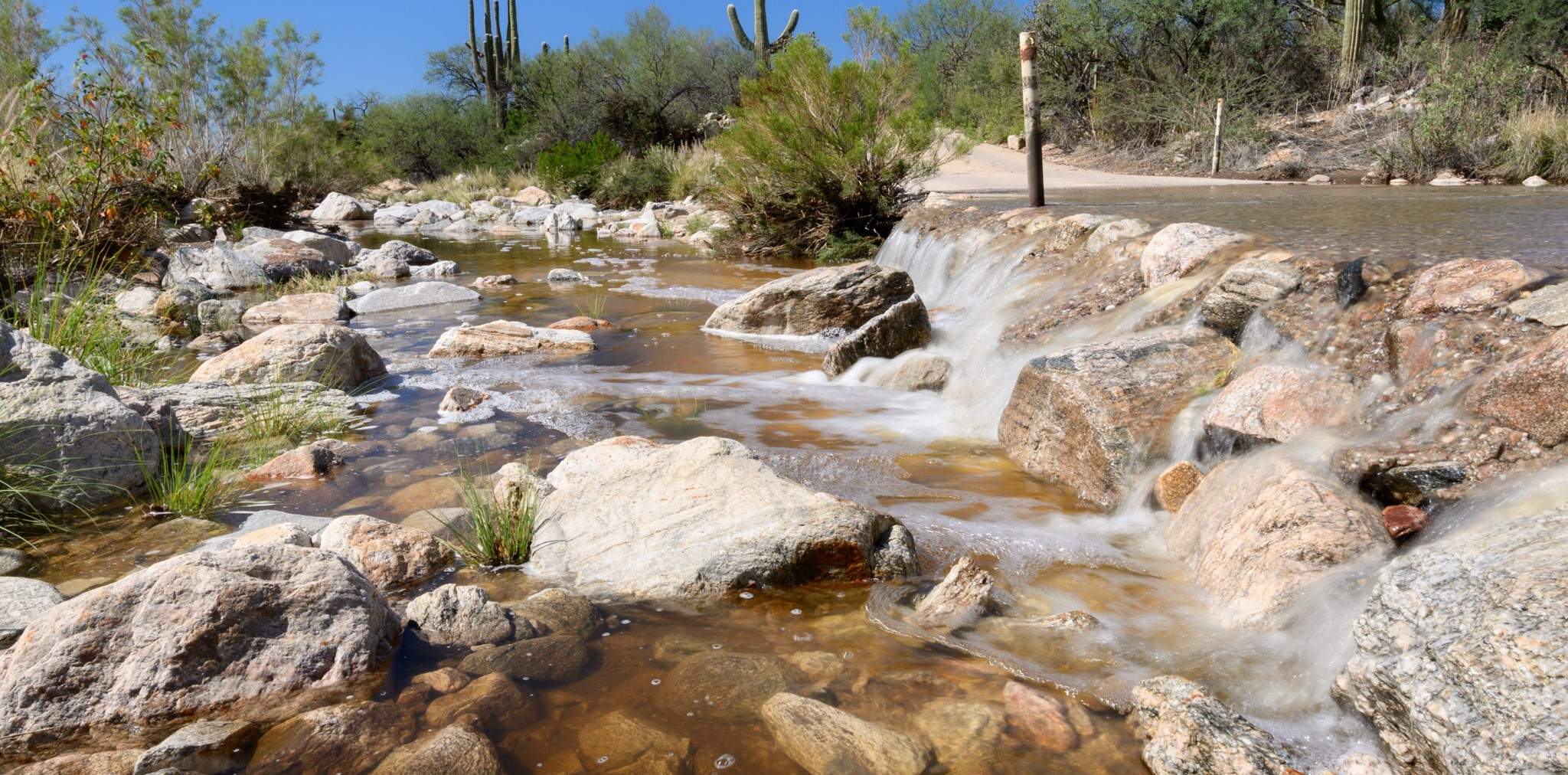
Severe drought impacts creek flow, groundwater levels, and habitat with less than half of average rainfall recorded
Summary of 2025 Water Year: Oct 1st, 2024 – Sep 30th, 2025
The scenic desert flows were scarce this water year. By March 2025, the rainfall data indicated it had been the driest six months on record. During the first 6 months of the 2025 water year, less than an inch of rain (0.91 inches) fell between October 1st, 2024 and March 31st, 2025. The total rainfall for this water year was 4.16 inches (NOAA), most of which fell in July 2025 (1.88 inches). This is less than half of our annual average (10.61 inches).
Other than the occasional ponding of rainfall, only the waterways that were supplied by treated wastewater or had consistent groundwater connection saw surface flow (water moving along the earth’s surface) across the Tucson basin. Groundwater connection occurs when water below ground, usually stored in an aquifer or underground pool of water, is full and connects to the surface, then flows above ground. As is highlighted in this year’s report, Sabino Creek, Ciénega Creek, and effluent-fed sites along the Santa Cruz River are the spaces with water permanence throughout the year. Other areas, including shallow groundwater sites like the Wentworth Bosque along the Tanque Verde Creek and the Rillito River at Craycroft Road, did have the occasional flow day. However, due to less than average rainfall the amount of flow was nowhere near what we typically would expect this water year.
In the 2025 water year report, we highlight data trends from our Flow365 Monitors including information about the Santa Cruz River at St. Mary’s Road and at Twin Peaks Road; Agua Caliente Creek at Milagrosa Lane; Pantano Creek at Tanque Verde Road; the Cañada Del Oro River at 1st; and Ciénega Creek at Marsh Station Road.