It’s time for you to give feedback on a very important policy: a new ordinance regulating large water users in the city of Tucson.
Last August, Tucson’s Mayor and Council approved an ordinance to regulate large quantity water users in response to the proposed Project Blue data center. The ordinance is a good starting point, but it needs to be strengthened to ensure water-guzzling industries like data centers are not welcomed into our community to overuse our precious desert waters.
I recently gave feedback on this ordinance through a stakeholder review committee, and a detailed Memo from our committee has been shared with the Mayor and Council for their study session on February 18th. Write or call the Mayor and your Council member to share what recommendations you agree with, and ask for a clear process for public input.
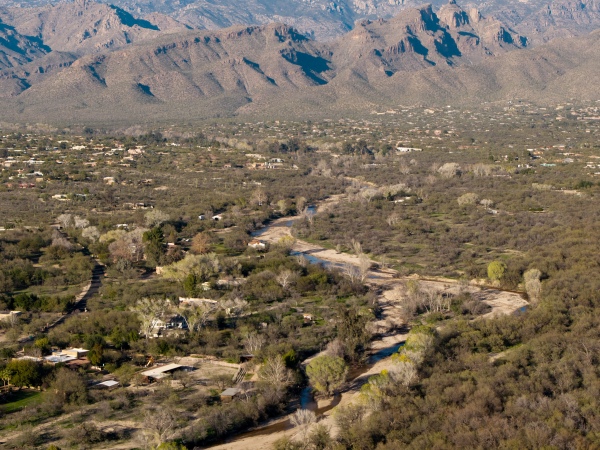
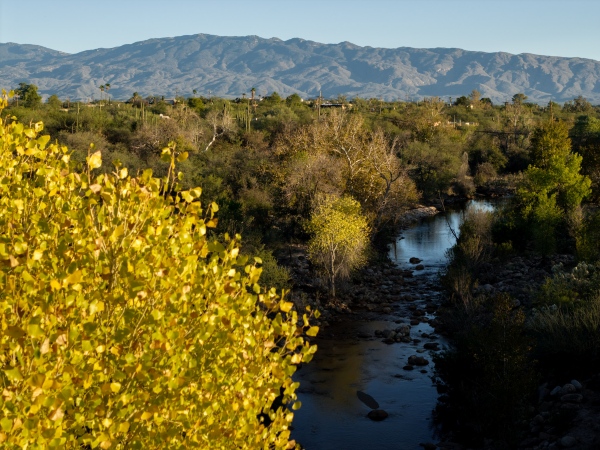
For example, Watershed Management Group recommends an explicit requirement that proposed water use does not reduce the City's groundwater aquifers or the surface waters of the Santa Cruz River, Rillito River, Tanque Verde Creek, or Sabino Creek. Many of the stakeholders supported this recommendation.
Although the stakeholder review process sometimes involved digging into the minutiae of policy decisions, the bigger question we should be asking ourselves is this: Should we welcome any new large water users to move into the Tucson region? How many new large water users can we sustainably serve? Large quantity water users are defined in the policy as new customers exceeding 7.4 million gallons (or 10,000 Ccf) monthly use. This category is larger than any current potable water users in Tucson; good examples of similar large water users are golf courses using recycled water.
My answer – zero. To protect our desert watershed, we should not be serving any new large water users.
Why zero? Here are a few compelling reasons: 1) we have overpumped our local groundwater for over a century, and we’re still trying to recover levels, 2) we pipe in very expensive Colorado Water that will be cut back 20-50% or more in the near future, and 3) and we are in a multi-decadal drought in a warming climate.
Not to mention, our leaders have called upon us for decades to conserve water. And we have! As I highlighted in an op-ed published in the Arizona Daily Star, the average Tucsonan has gone from using over 100 gallons per day to just over 70 gallons per day over the past thirty years. This collective effort must be respected.
The one exception might be a public service, like a hospital, but even a critical service such as this one should develop in a way that is as close as possible to net zero water use.
Our Large Quantity Water User Ordinance policy should make our values and priorities clear. Our policies should chart a pathway to a proactive, hydro-local water future that restores our desert rivers, cools our cities, and ensures we honor the sacred value water holds. Our policies should protect our local waters from businesses and industries that are not appropriate to our desert environment and have no problem wasting our water for their financial gain.
I am confident that this sustainable future is not only desirable but doable. Here in Southern Arizona, we are already working toward a hydro-local future, where we value and steward our local water resources. We have made strong gains in recovering some of our groundwater levels and restoring some stretches of our creeks and rivers, and now is the time to protect those gains and do even more. In addition to conserving and restoring our water resources, we have the opportunity to develop our community’s economy in a way that values our local diversity, our unique and beautiful Sonoran Desert, small businesses, arts, environment, and eco-tourism.
We need a revised, stronger Large Quantity Water User Ordinance that protects and preserves our precious groundwater, creeks, rivers, wetlands, rainwater, and recycled water.
How can you help?
- Read the Large Quantity Water User Ordinance Ad Hoc Committee’s memo about the ordinance. Visit the Recommended Revisions to Large Water User Ordinance file for details on my recommendations.
- Contact the Mayor and Council to voice your thoughts on revisions to the ordinance as soon as possible. They need to hear from you now while they are forming their opinions. You can call to ask what your Council person’s position is and to voice your recommendations. You can also email them. Not sure what Ward you are in? You can find your Ward on the Ward Map.
We will keep you apprised of future opportunities to make your voice heard on the Large Water Users Ordinance.