It’s been one year since the Mayor and Council rushed through a Large Quantity Water User Ordinance to protect Tucson from data centers. The Mayor and Council promised a public input process to improve the ordinance over the next year, and revisions are about to be proposed by Tucson Water. However, no public input process has taken place.
On July 31st, the Federal government released their 10-year plan to re-allocate Colorado River water to the seven basin states, including mandatory cuts for California, Nevada, and up to 40% cuts for Arizona. With the long-term drought, record heat, and current record lows of the Lake Mead and Lake Powell reservoirs, many of us are alarmed about our water supply in Tucson and other Western cities.
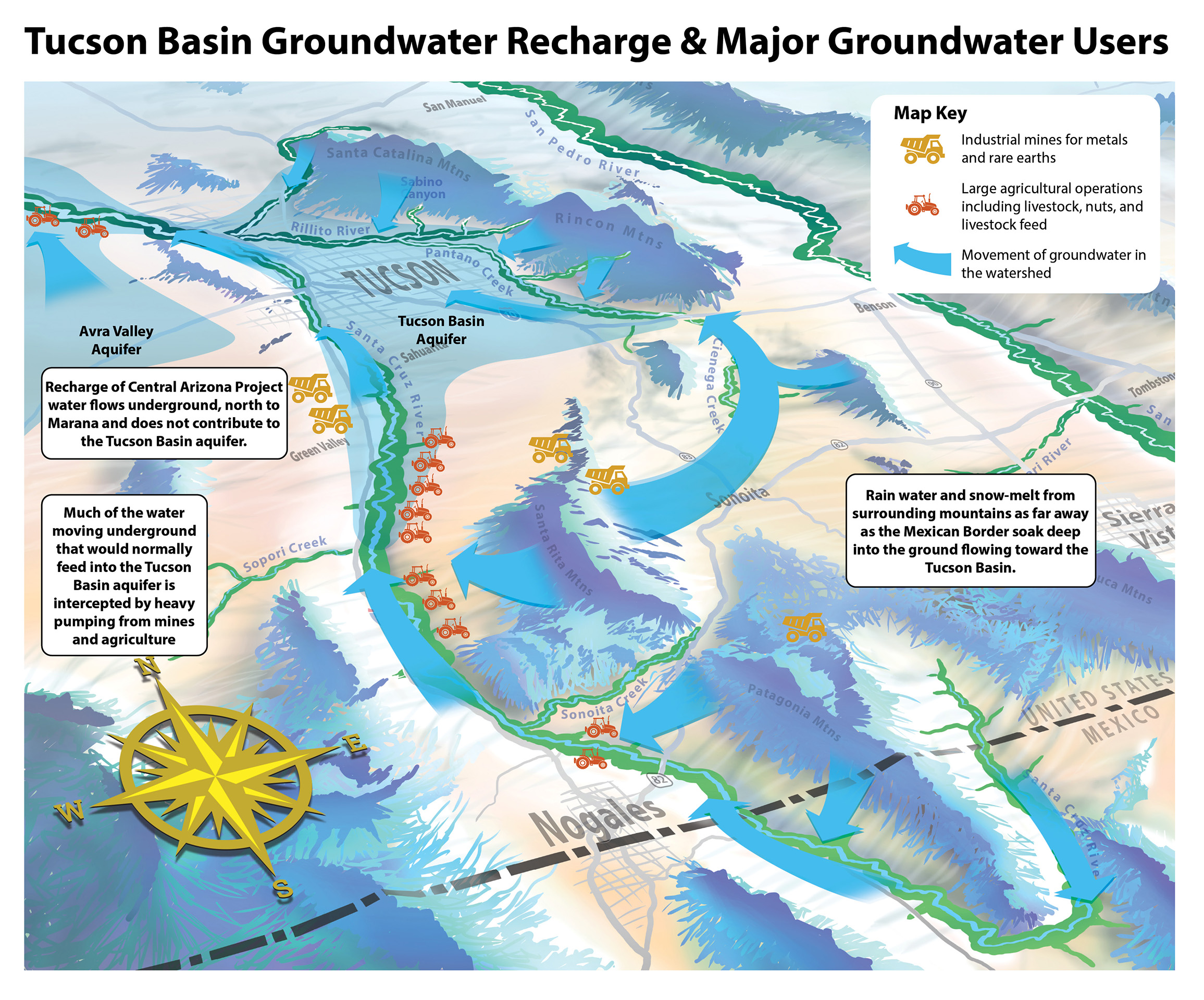
As the map below helps illustrate, the Tucson Basin faces several challenges to our groundwater supply, including pumping by large agricultural operations, industrial mines, and other major water users. We need to protect and preserve every drop of local water to ensure our community and environment can thrive in a hydro-local system with less imported water.
How can you help?
-
Contact the Mayor and your City Council Member to ask for a series of public town halls on revising the Large Quantity Water Users Ordinance. Let them know you would like the ordinance to be strengthened to specifically protect our local water supplies, especially in light of drought and pending Colorado River cuts.
-
Ask for a moratorium on any new large water users until Tucson’s Colorado River Water allocation cuts have been finalized.
-
Voice your support for the following revisions to the ordinance. These are Watershed Management Group’s priority recommendations:
- Reduce the large quantity water user threshold from 10,000 ccf/month annual average to 2500 ccf/month to reflect the limited water resources of our desert city.
- Add a requirement that all large water users need to have a net zero conservation plan. In other words, the large water user has to to ensure that all the water they consume, whether it’s potable or recycled water, needs to be replenished in our Tucson basin watershed, through wet-water strategies like offsite water conservation, in-channel recycled water recharge projects, and water harvesting systems that replace potable irrigation systems.
- Ensure the large water user does not reduce Tucson Water Service Area groundwater aquifers.
-
Ensure the large water user does not diminish the surface waters of the Santa Cruz River, Rillito River, Tanque Verde Creek, or Sabino Creek.
See the recording below of the info session Watershed held on the above reccomendations:
Background Information
We need a revised, stronger Large Quantity Water User Ordinance that protects and preserves our precious groundwater, rivers, wetlands, rainwater, and recycled water. Tucson Water is presenting their revisions to the Mayor and Council on September 22nd with minor changes that do not incoporate or address most of the recommendations made by the Stakeholder group that was convened in Nov - Dec 2025. The stakeholder group was made up of 42 individuals invited to participate, including Lisa Shipek, Watershed’s Co-Executive Director. Her recommendations and comments on all the Stakeholders' suggestions can be found here.
Now is a critical time to speak up to make sure the public is engaged before revisions are approved by the Mayor and Council. We need to work together to make sure the revised ordinance is a stronger policy that safeguards our local rivers and groundwater from data centers and other potential large water users.
-
Read the Large Quantity Water User Ordinance Ad Hoc Committee’s memo about the ordinance.
-
Our long-term drought continues and we are currently in an Extreme Drought. Learn more about our Extreme Drought and suggested response strategies on the Santa Cruz Watershed Collaborative’s website.
Our Large Quantity Water User Ordinance policy should make our values and priorities clear. Our policies should chart a pathway to a proactive, hydro-local water future that restores our desert rivers, cools our cities, and ensures we honor the sacred value water holds.
Recent News for Reference
- Federal plan makes steep Colorado River water cuts to Arizona, California and Nevada, High Country News, Aug 4, 2026
- Colorado River's two big lakes drop to lowest water levels on record, AZ Daily Star, Updated Aug 3, 2026